Contact
  Locations
 .png) Call
Call 
Allergies and Testing
See where FeNO fits within the broader diagnostic service category.
View guideDiagnostic Guide
Fractional exhaled nitric oxide, or FeNO, testing measures nitric oxide in a slow, steady exhaled breath. The result can support assessment of type 2 or eosinophilic airway inflammation and may help an allergist judge whether anti-inflammatory asthma treatment is likely to help. FeNO complements your history, exam, and lung function testing; it does not diagnose or rule out asthma by itself.

Patient plan
For exhaled nitric oxide (feno) testing patients: An exhaled nitric oxide test measures one marker of airway inflammation and adds context to asthma evaluation, spirometry, and treatment decisions.
Exhaled Nitric Oxide (FeNO) Testing is for patients whose main question is what feno measures in the airways. A focused visit is most useful when symptoms, timing, or a prior result remain unclear.
During a exhaled nitric oxide (feno) testing evaluation, the clinician can use the history and examination to decide whether what happens during a feno breath test should be part of the visit, and whether how food, exercise, smoking, illness, and medication can affect results would change the plan.
To prepare for exhaled nitric oxide (feno) testing, bring the timeline, medicines, prior reports, photographs, and the specific exposure or symptom question that led you here. Review when feno adds context to spirometry and asthma evaluation before the appointment.
Ask what exhaled nitric oxide (feno) testing can and cannot establish, including why feno does not diagnose or rule out asthma by itself. A test result should not be used alone to make a major diet, medicine, or exposure change.
If exhaled nitric oxide (feno) testing symptoms match when breathing symptoms need immediate care, seek urgent care rather than waiting for a scheduled test. Emergency treatment takes priority over diagnostic clarification.
If exhaled nitric oxide (feno) testing does not answer the question, the next discussion may include Allergies and Testing, Pulmonary Function Testing, Asthma Evaluation or coordination with another clinician.
Before a exhaled nitric oxide (feno) testing visit: Review the related breathing tests, then find a clinic to confirm preparation and availability.
Airway Inflammation Marker
Inflamed airway lining can produce increased nitric oxide. A FeNO device measures its concentration in exhaled breath and reports the result in parts per billion.
A higher result may support the presence of type 2 airway inflammation. A lower result may make this pattern less likely at that moment, but it does not exclude asthma or another cause of breathing symptoms.
FeNO does not measure blood oxygen, total lung capacity, or airflow obstruction. Those questions require other assessments, such as pulse oximetry or pulmonary function testing.
The Breathing Maneuver
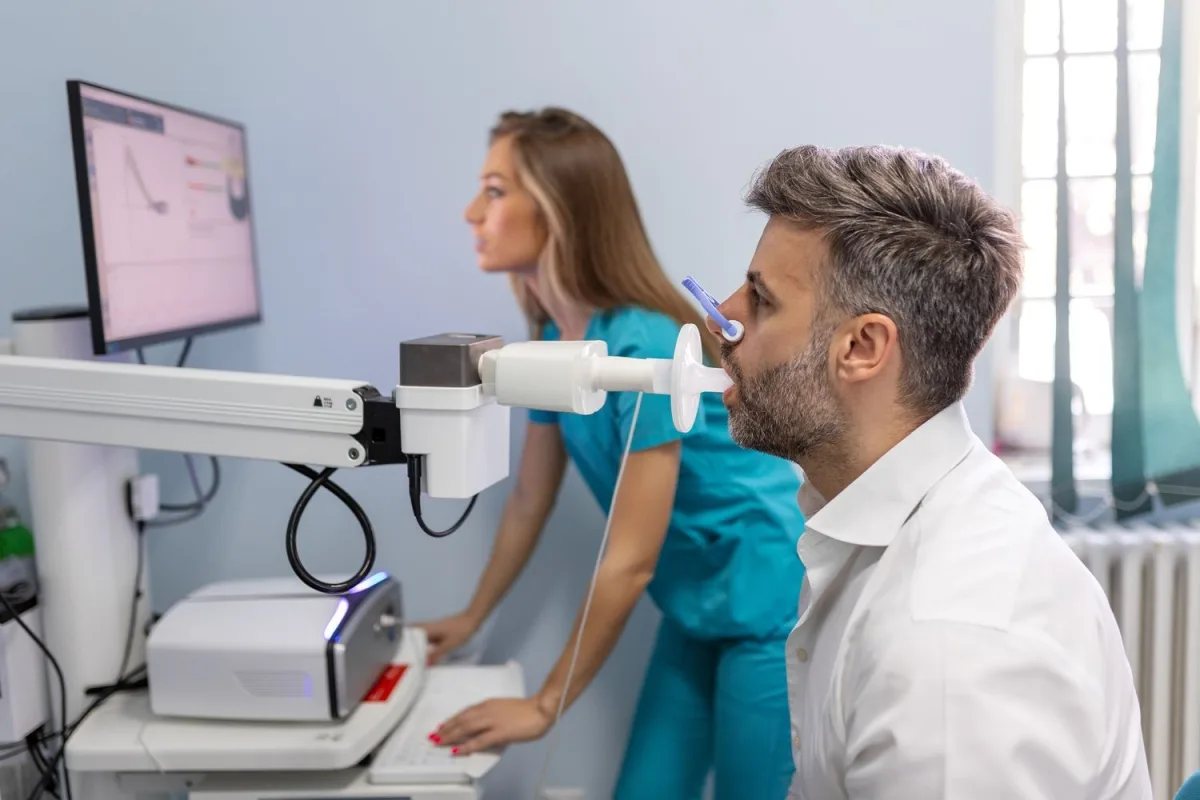
You will usually sit upright, breathe through a mouthpiece, take in a full breath, and then exhale slowly at a controlled rate. Visual or audio cues from the device help you maintain the correct airflow.
The measurement may be repeated to obtain a reliable result. There are no needles and no radiation. Most patients can return to their usual activities immediately after the test.
Protect Test Quality
Follow the instructions provided for your appointment. Do not stop an inhaler or other asthma medication unless the ordering clinician specifically tells you to do so.
Food, nitrate-rich meals, smoking, strenuous exercise, recent spirometry, respiratory infections, and some medications can affect FeNO. You may be asked to avoid food, drinks, smoking, strenuous exercise, and other forceful breathing tests for a period before your measurement.
Tell the clinical team if you recently had a cold, asthma flare, unusual allergen exposure, or change in medication.
The Number Needs Context
A FeNO number should never be interpreted in isolation. Your clinician considers your age, symptoms, examination, allergy history, current corticosteroid treatment, tobacco exposure, recent infection, test technique, and spirometry results.
A change over time may be more informative than a single measurement. FeNO can help guide a treatment discussion, but medication decisions should also reflect symptom control, exacerbation history, lung function, adherence, and your individual treatment goals.
A Supporting Test
FeNO may be useful when:
FeNO is not intended to evaluate a medical emergency or replace an asthma action plan.
Not an Emergency Test
FeNO is not an emergency test. Follow your asthma action plan for an acute flare. Call 911 for severe breathing difficulty, blue or gray lips, difficulty speaking, confusion, fainting, or symptoms that do not improve with prescribed rescue treatment.
Patient Questions
No. Asthma is a clinical diagnosis. FeNO can provide supporting evidence of type 2 airway inflammation, but some people with asthma have a low result and some elevated results occur in other clinical settings.
Not by itself. The number reflects one aspect of airway inflammation. Severity and control depend on symptoms, exacerbations, lung function, medication needs, and other clinical information.
No. FeNO measures nitric oxide associated with airway inflammation. Spirometry measures how much air you can exhale and how quickly you can exhale it. The tests answer different questions and may be used together.
Only if your clinician gives you specific instructions. Stopping corticosteroids or bronchodilators without guidance can affect both your symptoms and the interpretation of the test.
Yes. Respiratory infections and recent allergen exposure may affect airway nitric oxide. Tell the clinical team about recent symptoms before testing.
Related Care Guides
See where FeNO fits within the broader diagnostic service category.
View guideCompare an inflammation marker with tests that measure airflow, volume, and gas transfer.
View guideReview how symptoms, lung function, and supporting tests are interpreted together.
View guideReview the related breathing tests, then find a clinic to confirm preparation and availability.

For Business