Contact
  Locations
 .png) Call
Call 
Spirometry
Read the focused guide to the most common airflow measurement within pulmonary testing.
View guideDiagnostic Guide
Pulmonary function tests are breathing measurements that show how air moves into and out of your lungs and, when ordered, how well gases transfer. At Modena Health, spirometry may be performed before and after a bronchodilator to help evaluate airflow limitation and treatment response. Your clinician interprets the measurements together with your symptoms, examination, and medical history.
Patient plan
For pulmonary function testing: what to expect patients: Pulmonary function testing measures airflow, lung volume, and gas transfer. Learn how to prepare and how results fit with asthma and FeNO evaluation.
Pulmonary Function Testing: What to Expect is for patients whose main question is spirometry, bronchodilator response, lung volumes, and diffusion testing. A focused visit is most useful when symptoms, timing, or a prior result remain unclear.
During a pulmonary function testing: what to expect evaluation, the clinician can use the history and examination to decide whether what happens during spirometry should be part of the visit, and whether how to prepare for reliable pulmonary function results would change the plan.
To prepare for pulmonary function testing: what to expect, bring the timeline, medicines, prior reports, photographs, and the specific exposure or symptom question that led you here. Review when illness or recent procedures may change the test plan before the appointment.
Ask what pulmonary function testing: what to expect can and cannot establish, including how clinicians interpret pulmonary function patterns. A test result should not be used alone to make a major diet, medicine, or exposure change.
If pulmonary function testing: what to expect symptoms match how pft results fit with feno and asthma evaluation, seek urgent care rather than waiting for a scheduled test. Emergency treatment takes priority over diagnostic clarification.
If pulmonary function testing: what to expect does not answer the question, the next discussion may include Spirometry, Exhaled Nitric Oxide Testing, Asthma Evaluation or coordination with another clinician.
Before a pulmonary function testing: what to expect visit: Follow the ordering team’s instructions, bring every inhaler, and use the clinic directory to confirm the appointment.
Tests Answer Different Questions
Pulmonary function testing is an umbrella term. Depending on the clinical question and what is available at the testing location, an order may include one or more measurements:
Confirm which measurements are included when scheduling your appointment.

A Repeatable Breathing Maneuver
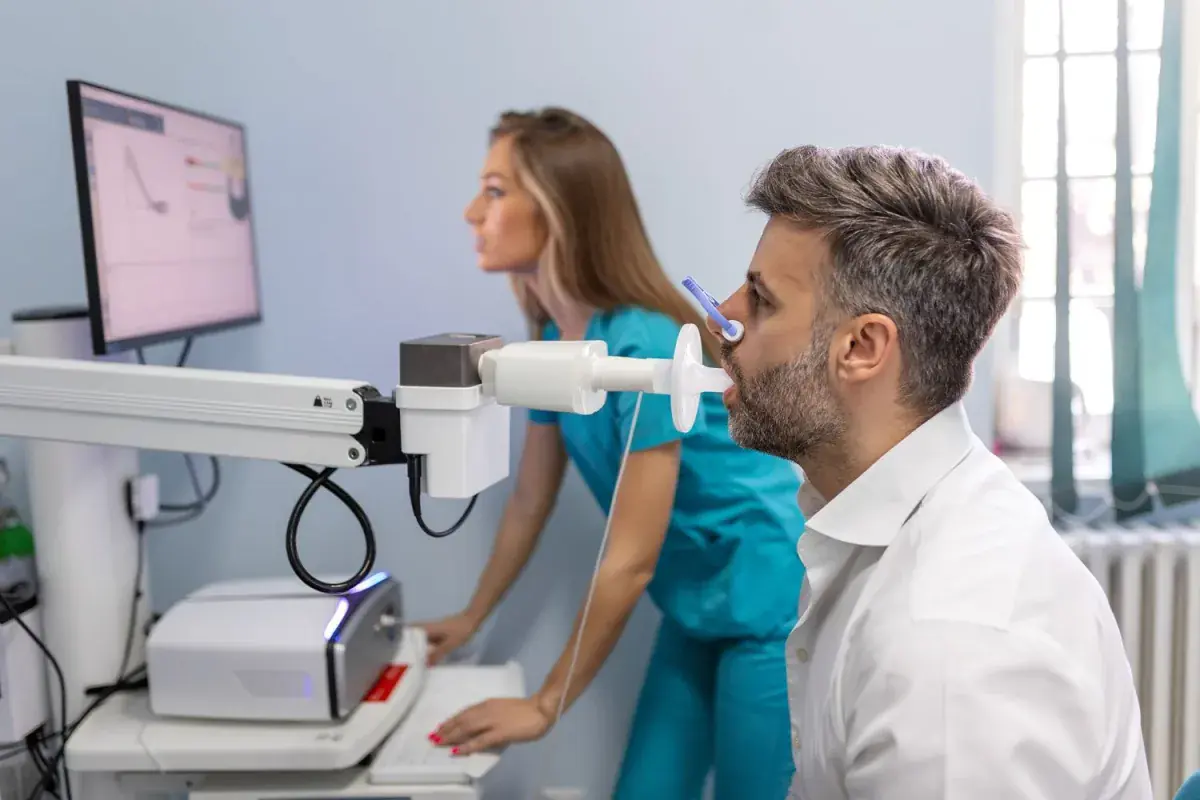
For spirometry, you will usually wear a nose clip and seal your lips around a clean mouthpiece. After taking a full breath, you will blow out as hard, fast, and completely as possible.
The test is repeated so the clinical team can confirm that the measurements are consistent and technically acceptable. Coaching is an important part of the test, and it can take practice to perform the maneuver correctly.
When bronchodilator testing is ordered, you may inhale a breathing medication and repeat the measurements after the required waiting period.
Protect Test Reliability
Follow the instructions supplied for your specific appointment. Ask whether any inhalers should be withheld and for how long. Do not stop a prescribed breathing medication unless the ordering clinician tells you to do so.
For more reliable measurements, you may be instructed to:
Tell the office if you have a cold, flu, or other respiratory infection because the appointment may need to be rescheduled.
Patterns, Not One Number
Spirometry commonly reports forced expiratory volume in one second, forced vital capacity, and their ratio. Results are compared with appropriate reference values and evaluated for technical quality.
An abnormal pattern can support the presence of airflow obstruction, possible restriction, or another physiologic change. Pulmonary function measurements alone do not identify one specific disease. Your clinician considers test quality, biological variability, symptoms, prior results, examination, and other diagnostic information.
Normal baseline spirometry does not always rule out asthma. FeNO testing, repeated spirometry, or a bronchial challenge may be considered when clinically appropriate.
Safety Before Testing
Tell the team before testing if you recently had:
Forceful breathing can briefly cause coughing, fatigue, or lightheadedness. Stop the maneuver and tell the staff immediately if you develop chest pain, severe shortness of breath, dizziness, or feel faint.
Severe Symptoms Need Care
Pulmonary function testing is not an emergency evaluation. Call 911 for severe current breathing difficulty, blue or gray lips, confusion, fainting, severe chest pain, or symptoms that do not improve with prescribed rescue treatment.
Connect the Results
Lung function testing is interpreted together with symptoms, examination findings, medication use, and the clinical question. Learn more about asthma evaluation, how FeNO testing answers a different question, and the elements of an individualized asthma treatment plan. A clinician should decide whether any of these evaluations are suitable and how to prepare.
Patient Questions
Spirometry is the most common pulmonary function test, but a broader PFT evaluation may also include lung volumes or diffusing capacity. Ask which measurements your appointment includes.
Only when the ordering clinician provides specific instructions. The correct withholding period depends on the medication and the purpose of the test.
No. Some patients with asthma have normal spirometry between episodes. Your clinician may use symptom history, bronchodilator testing, FeNO, peak-flow monitoring, or another test when needed.
Several acceptable efforts help confirm that the result is reproducible and reflects your best performance rather than technique or an incomplete breath.
It depends on which tests were ordered and whether bronchodilator measurements are included. The scheduling team should provide an estimate for your specific appointment.
Related Care Guides
Read the focused guide to the most common airflow measurement within pulmonary testing.
View guideCompare airway-inflammation information with mechanical lung-function results.
View guideSee how breathing symptoms and objective evidence are assessed together.
View guideFollow the ordering team’s instructions, bring every inhaler, and use the clinic directory to confirm the appointment.

For Business